

Countries Where Weed Is Legal in 2026: Cannabis Laws Guide

Photo by Tima Miroshnichenko
Executive Summary
Countries where weed is legal in 2026 include several very different cannabis law models. Canada has one of the clearest national recreational cannabis systems, with legal adult possession and authorized retail sales. Uruguay also legalized cannabis nationally, but legal purchase is limited to registered residents or citizens. Germany, Malta, Luxembourg, Czechia, South Africa, and Georgia each allow some form of adult cannabis use, possession, home cultivation, private use, or cannabis associations, but the rules are not the same as a simple dispensary system for tourists.
The most important thing to understand is that “legal weed” does not always mean you can buy cannabis, smoke it publicly, carry it across borders, or use it as a visitor. Some countries have recreational cannabis laws, some only allow medical cannabis, some have decriminalized small amounts, and others simply tolerate cannabis in limited settings. This guide explains where weed is legal in the world, which countries are more tourist-friendly, where medical marijuana is available, and why travelers should never cross international borders with cannabis.
Apply for a Medical Marijuana Card Online Today
Join over 100,000 patients who have chosen Green Health Docs as their medical cannabis doctors. We have a 99% approval rate and offer a 100% money back guarantee!
Where Is Weed Legal in the World?
Weed is legal in a limited number of countries, but the rules vary widely. Some countries allow adults to buy cannabis from regulated stores. Others allow only home cultivation or private possession. Some countries allow medical marijuana but not recreational use. Others have decriminalized small amounts without making cannabis fully legal.
This is why country-by-country cannabis laws can be confusing. A person may hear that weed is “legal” in a country, then later discover that tourists cannot buy it, public smoking is still banned, retail sales are not allowed, or only medical cannabis is permitted. Before using cannabis abroad, check the current law for the specific country, city, and setting.
What “Legal Weed” Means by Country
Legal weed can mean several different things. In Canada, it may mean adults can buy cannabis from authorized retailers. In Uruguay, it may mean cannabis is legal nationally but legal pharmacy access is limited to registered residents or citizens. In Germany, it may mean limited possession, home growing, and cannabis cultivation associations rather than broad retail dispensaries.
The safest way to read any country list is to ask: legal for whom, in what amount, where, and how? Those details matter more than the word “legal” by itself.
Recreational vs. Medical vs. Decriminalized Cannabis
Recreational cannabis means adults can use cannabis for non-medical purposes under the country’s rules. Medical cannabis means cannabis is available for patients through a medical program, prescription, authorization, or license. Decriminalized cannabis means possession of small amounts may lead to a fine or civil penalty instead of criminal prosecution, but cannabis is not fully legal.
Tolerated cannabis is different again. In some places, authorities may allow certain cannabis activity in practice, even though the law remains restrictive. That can create confusion for travelers who assume tolerance equals full legalization.
Why Tourist Access Is Different From Legalization
A country can legalize cannabis without creating legal access for tourists. Uruguay is the clearest example: cannabis is legal nationally, but legal purchase through pharmacies is tied to registration and residency or citizenship requirements. Some European countries also allow home growing or cannabis associations, which may not help short-term visitors.
Tourists should also remember that cannabis laws can vary by city, region, or province. A product that is legal to buy in one place may be illegal to bring across a border, carry into an airport, or use in public.
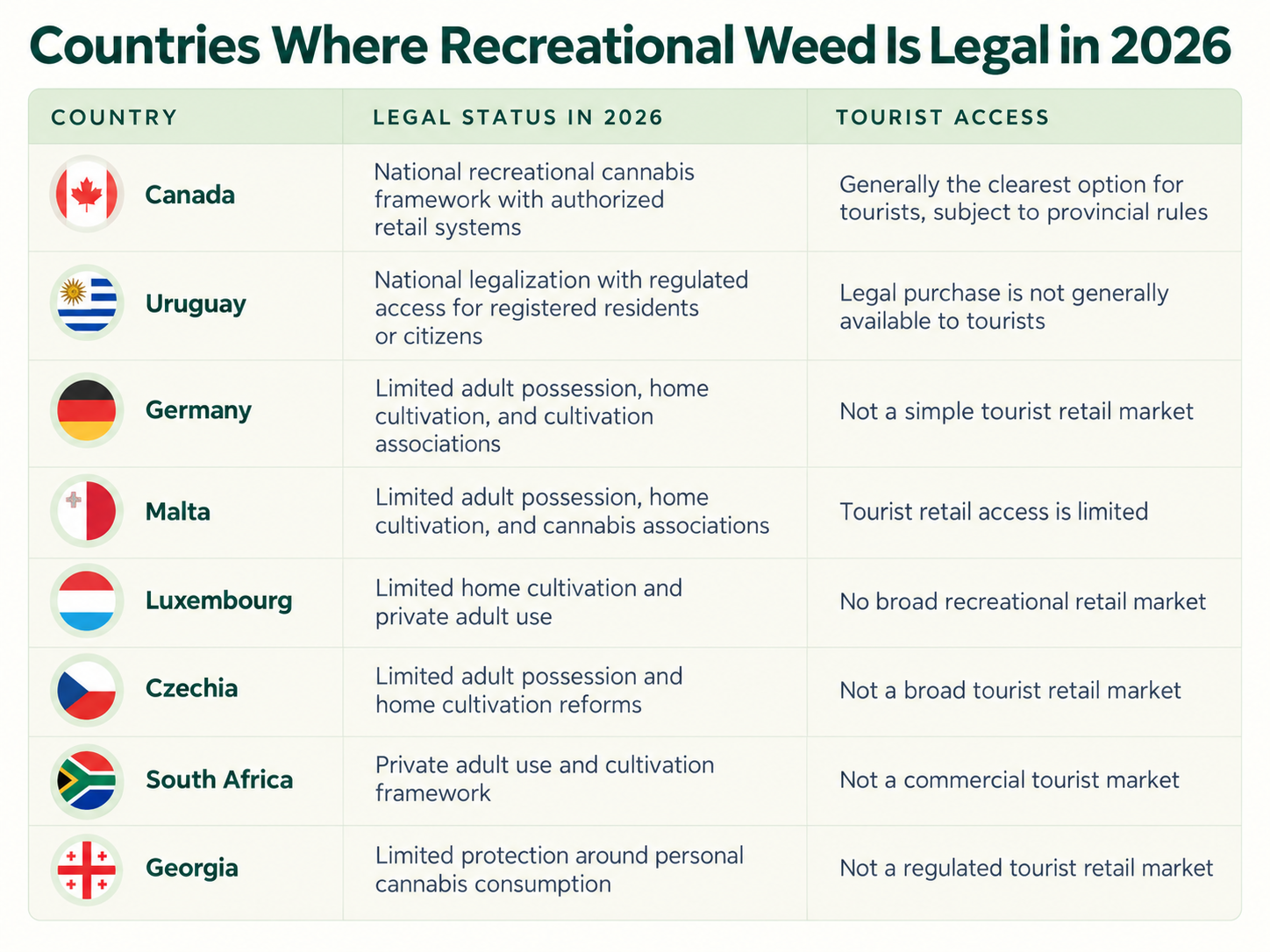
The countries above have some form of legal adult-use, recreational, private-use, or limited non-medical cannabis framework. The rules are not identical, and not every country has legal retail sales. Some are much more restrictive than others.
This table should not be treated as travel permission. Cannabis laws change, and many countries still restrict public use, sales, possession amounts, transportation, advertising, and driving under the influence.
Canada
Canada is one of the clearest examples of a country where recreational cannabis is legal nationwide. Adults can generally buy cannabis from authorized retailers and possess limited amounts in public, subject to provincial and territorial rules. Minimum age, store systems, public-use rules, and home-growing rules can vary by province or territory.
Canada is also one of the more tourist-friendly cannabis destinations because legal retail access is available through authorized provincial or territorial systems. However, tourists still need to follow local age limits, possession rules, public-use restrictions, and impaired-driving laws.
Most importantly, cannabis cannot be taken across Canada’s international borders. Even if cannabis is legal in Canada and legal where you are going, crossing an international border with cannabis can create serious legal problems.
Uruguay
Uruguay was the first country to legalize cannabis nationally. Its system includes home cultivation, cannabis clubs, and pharmacy access through registration. However, Uruguay is not a simple cannabis tourism destination.
Legal pharmacy access is tied to registration, and registration is generally limited to people with Uruguayan citizenship or permanent residency. That means visitors should not assume they can legally buy cannabis just because cannabis is legal in the country.
Uruguay is still important because it helped shape global cannabis legalization, but tourists should treat it differently from Canada. Legal status does not automatically mean open visitor access.
Germany
Germany changed its cannabis laws in 2024 and now allows limited adult possession, limited home cultivation, and regulated cannabis cultivation associations under specific rules. Adults may possess limited amounts, and residents may be able to grow a small number of plants at home. Cannabis associations can distribute cannabis to members under strict conditions.
Germany does not operate like a U.S.-style dispensary market. Tourists should not assume they can walk into a store and buy cannabis recreationally. Public-use restrictions, membership rules, quantity limits, and residency-related requirements matter.
Germany is one of the most important recent additions to any global cannabis law guide, but its model is controlled and limited. It should be listed as a legal cannabis country with important restrictions.
Malta
Malta legalized limited adult cannabis possession, home cultivation, and regulated cannabis associations. Adults may be allowed to possess limited amounts and grow a small number of plants at home for personal use. Cannabis associations are intended to create a controlled source for members under specific rules.
Malta’s law is significant because it made the country one of the first in Europe to create a national adult-use cannabis framework. However, it does not create a broad commercial retail market for tourists. Visitors should not treat Malta like a cannabis-shopping destination.
As with other limited legalization models, public use, possession amounts, age limits, and access rules still matter. Cannabis may be legal in certain forms, but that does not mean every cannabis activity is allowed.
Luxembourg
Luxembourg allows adults to consume cannabis at home and cultivate a limited number of cannabis plants per household. Its model focuses on private use and home cultivation rather than commercial recreational sales. Public possession and public use remain more restricted.
This makes Luxembourg a legal cannabis country in a limited sense. It is not a country where tourists should expect to buy recreational cannabis from stores. The law is more about private adult use than cannabis tourism.
Czechia
Czechia has moved toward limited adult cannabis reform, including personal possession and home cultivation rules for adults. The new framework is more permissive than older laws, but it should not be confused with a broad recreational dispensary market.
Czechia is worth including because of its 2026 reform direction and its importance in European cannabis policy. However, travelers should verify the latest possession, cultivation, public-use, and purchase rules before making any decisions.
South Africa
South Africa allows private adult cannabis use and cultivation under its Cannabis for Private Purposes framework. The law is focused on private use, private possession, and private cultivation by adults. It does not create a simple commercial recreational market like Canada.
Tourists should be especially careful in South Africa because private use is different from public use, sale, or commercial access. Cannabis may be legal in private settings, but buying, selling, carrying, or using it publicly can still create legal risk.
Georgia
Georgia is sometimes listed among countries with legal or decriminalized cannabis because court decisions limited punishment for personal cannabis consumption. However, Georgia does not have a regulated recreational cannabis market. Possession, sale, cultivation, and public-use rules can still create risk.
For that reason, Georgia should be described carefully. It is not a tourist retail market, and travelers should not assume that cannabis is broadly legal in the way it is in Canada.

Photo by Brandon Nickerson
Weed-Friendly Countries for Tourists
The most tourist-friendly cannabis countries are not always the same as the countries where cannabis is technically legal. Tourist access depends on whether visitors can legally buy cannabis, where they can use it, whether public use is allowed, and whether the country has authorized retail or medical access for visitors.
Canada is the clearest example of a country where tourists can generally buy legal cannabis from authorized retailers, as long as they meet the legal age and follow provincial or territorial rules. Some other destinations may be cannabis-friendly in culture or reputation, but the legal details are often more limited.
Countries Where Tourists Can Legally Buy Cannabis
Canada is the best country-level example for legal tourist retail access. Visitors of legal age can generally purchase cannabis from authorized retailers, depending on the province or territory. They still cannot take cannabis across the border, mail it internationally, drive while impaired, or ignore local public-use rules.
Some places in the world may allow limited medical cannabis access for visitors under special rules, but those programs are usually more restrictive than recreational retail. Tourists should verify requirements before traveling.
Countries Where Weed Is Legal but Tourist Access Is Limited
Uruguay, Germany, Malta, Luxembourg, Czechia, South Africa, and Georgia all have important cannabis reforms, but they are not all tourist retail destinations. Some limit legal purchase to registered residents, private settings, home growing, or association members.
This distinction is important because travelers often search for “countries where weed is legal” when what they really want to know is “where can I legally buy and use cannabis as a visitor?” Those are not always the same question.
Countries Where Cannabis Is Tolerated but Not Fully Legal
The Netherlands is the best-known example of cannabis tolerance. Coffeeshop sales are tolerated under specific rules, but cannabis is not simply legal in every way. The government’s tolerance policy includes restrictions, and municipalities may apply rules differently.
Spain is another commonly misunderstood example. Private cannabis clubs exist, but Spain does not have a simple national recreational retail market. Portugal decriminalized personal drug possession but did not create legal recreational cannabis sales. Jamaica allows limited use and has a licensed medical cannabis system, but cannabis remains regulated and should not be treated as fully unrestricted.
Is Weed Legal in Belize?
Weed is not fully legal in Belize. Belize decriminalized possession of small amounts of cannabis, generally discussed as 10 grams or less, but decriminalization is not the same thing as legalization. There is no broad legal recreational dispensary system for tourists.
Belize is an important keyword topic because many travelers associate the country with a relaxed cannabis culture. The legal reality is more limited. Small-scale possession may be treated differently than in the past, but cannabis sale, trafficking, cultivation, and public use can still create legal problems.
Belize Cannabis Laws for Personal Use
Belize amended its Misuse of Drugs Act in 2017 to decriminalize possession of cannabis in amounts not exceeding 10 grams under certain conditions. The reform reduced criminal consequences for small amounts, but it did not create a full recreational cannabis market.
That means a person should not assume cannabis is legal to buy, sell, or use publicly in Belize. The law is more limited than legalization.
Can Tourists Smoke Weed in Belize?
Tourists should be cautious about smoking weed in Belize. Decriminalization of small amounts does not mean tourists can buy cannabis legally or smoke anywhere they want. Private premises rules, consent, public-use restrictions, and possession limits may matter.
If you are visiting Belize, do not rely on what other tourists say. Check current law and avoid buying cannabis from illegal sources.
Is Weed Legal in Central America?
Central America does not have a broad legal recreational cannabis market like Canada. Belize has decriminalized small amounts, but that is not the same as full legalization. Other countries in the region may have stricter cannabis laws and penalties.
Travelers should verify country-specific laws before visiting. In many places, even small amounts of cannabis can create serious legal issues.
Countries Where Medical Marijuana Is Legal
Medical marijuana is legal or available in many more countries than recreational cannabis. However, medical cannabis programs vary widely. Some countries allow prescriptions for certain cannabis-based medicines, while others allow flower, oils, extracts, or pharmaceutical cannabinoid products under strict rules.
Medical cannabis access also does not always help tourists. A U.S. medical marijuana card may not be recognized abroad, and many countries require local authorization, prescriptions, or residency. If you use medical cannabis, do not assume your patient status travels with you.
Medical Cannabis in North America
Canada has both recreational and medical cannabis frameworks. In the United States, medical marijuana laws vary by state, and cannabis remains subject to federal rules. Mexico has court decisions and medical cannabis developments, but it does not offer a simple national recreational retail system for visitors.
Patients in the U.S. should also remember that state medical marijuana cards generally do not provide international protection. Crossing borders with cannabis can create serious legal risk.
Medical Cannabis in Europe
Several European countries allow some form of medical cannabis, but access varies by country. Germany has a major medical cannabis framework in addition to its adult-use reforms. The United Kingdom, Portugal, Italy, the Netherlands, Poland, and other countries have medical cannabis access in certain circumstances, but rules are not uniform.
Europe is especially important to research carefully because medical access, private use, decriminalization, and adult-use reforms can all exist in different combinations. A country may allow medical cannabis while still banning recreational possession or public use.
Medical Cannabis in Latin America and the Caribbean
Medical cannabis laws exist in several parts of Latin America and the Caribbean, including countries with licensed medical or therapeutic cannabis industries. Jamaica, Colombia, Argentina, Brazil, Peru, and others have various medical or regulatory frameworks. However, these laws often focus on patients, prescriptions, licensing, or controlled production rather than tourist recreational use.
Uruguay is the standout country for national legalization, but tourist purchase is limited. Belize is decriminalized for small amounts but not fully legal. Mexico remains legally complicated and should not be treated as a simple recreational destination.
Medical Cannabis in Asia, Africa, and Oceania
Medical cannabis access exists in parts of Asia, Africa, and Oceania, but the rules can be strict and change quickly. Australia and New Zealand have medical cannabis pathways. South Africa has private adult-use protections as well as broader cannabis reforms. Thailand’s cannabis rules have shifted significantly and are now focused more tightly on medical use, with recreational access restricted.
Travelers should be particularly careful in countries with strict drug laws. A product that is legal in one country can be a serious offense in another.

Photo by Pavel Danilyuk
Countries Where Weed Is Decriminalized or Tolerated
Decriminalized or tolerated cannabis laws are often misunderstood. These policies may reduce criminal penalties for small amounts or allow limited use in practice, but they do not create full legalization. Buying, selling, growing, or using cannabis publicly may still be illegal.
This category includes some of the world’s most searched cannabis destinations, including the Netherlands, Portugal, Spain, Jamaica, Colombia, Mexico, and Belize. Each has its own rules and risks.
Netherlands
The Netherlands is famous for coffeeshops, but cannabis is not fully legal in the same way it is in Canada. Coffeeshop sales are tolerated under specific rules, while cultivation and supply have historically remained restricted. The country is also testing regulated supply through a controlled cannabis experiment in participating municipalities.
Tourists should check local rules before visiting coffeeshops. Some municipalities restrict coffeeshop access to residents, and rules can vary by location.
Portugal
Portugal decriminalized personal possession of drugs, including cannabis, but it did not create a legal recreational cannabis retail market. Decriminalization can reduce criminal penalties, but cannabis remains controlled.
This makes Portugal very different from Canada. Visitors should not assume they can legally buy cannabis just because personal possession is treated differently than in countries with strict criminal penalties.
Spain
Spain is often associated with cannabis clubs, especially in cities like Barcelona, but cannabis is not broadly legal for commercial recreational sale. Private use and private clubs exist in a complicated legal environment, and public use or possession can still create legal problems.
Tourists should be cautious with cannabis clubs. Membership rules, local enforcement, and legal risk can vary. Spain should not be treated like a straightforward cannabis retail market.
Jamaica
Jamaica has decriminalized limited ganja possession and has a licensed medical cannabis industry. Limited recreational and religious use is permitted in certain contexts, but cannabis remains regulated. The country’s reputation as cannabis-friendly does not mean all cannabis activity is legal.
Tourists should use only lawful channels and avoid assuming that public use, unlicensed purchase, or travel with cannabis is allowed.
Colombia
Colombia has medical cannabis and decriminalization-related policies, but it does not operate like a broad legal recreational cannabis market for tourists. Personal possession rules and enforcement can be complicated, and commercial recreational sales are not the same as in Canada.
Travelers should verify current rules before using cannabis in Colombia and should not travel internationally with cannabis.
Mexico
Mexico has important court decisions around adult personal cannabis use, but it does not have a simple nationwide recreational retail market like Canada. Legal developments around self-consumption do not automatically mean tourists can legally buy cannabis from stores or carry it freely.
Mexico should be treated as a legal gray area for visitors. Do not assume that cannabis is fully legal, easy to buy, or safe to travel with.
Countries Where Weed Is Still Illegal or High Risk
Weed remains illegal or high risk in many countries. Some countries impose serious penalties for cannabis possession, trafficking, importing, exporting, or public use. In certain destinations, even small amounts can lead to arrest, prosecution, fines, imprisonment, deportation, or travel bans.
Travelers should be especially cautious in countries known for strict drug enforcement. Do not assume that a medical marijuana card, a CBD label, or legalization in your home state or country will protect you abroad.
Countries With Harsh Cannabis Penalties
Some countries have very strict cannabis laws and penalties. These can include countries in parts of Asia, the Middle East, and other regions where controlled-substance laws are heavily enforced. Penalties may apply to possession, use, import, export, trafficking, or even cannabis residue in some situations.
Before traveling, check official government travel guidance, embassy resources, and local law. Avoid relying on social media, old travel blogs, or word of mouth for cannabis law advice.
Why Travelers Should Avoid Bringing Cannabis Across Borders
Never bring cannabis across international borders unless you have explicit authorization from every relevant authority, which is rare. This includes flower, edibles, vapes, oils, tinctures, concentrates, CBD products, and medical cannabis. Border rules can be stricter than domestic possession rules.
Even if you are traveling from one legal place to another legal place, crossing a border with cannabis can still be illegal. This is one of the most important rules for cannabis travelers.
Why CBD and Hemp Products Can Still Be Risky Abroad
CBD and hemp products are not legal everywhere. Some countries regulate CBD as a controlled substance, restrict THC content more strictly than the U.S., or require special documentation. Labels can also be misleading, especially with unregulated products.
If you are traveling internationally, do not assume CBD gummies, oils, vapes, or creams are safe to pack. Check the destination country’s law before bringing any cannabis-derived product.
Can You Travel Internationally With Weed?
In most cases, you should not travel internationally with weed. Cannabis may be legal where you live, legal where you are going, or legal for medical use, but crossing an international border is a separate legal issue. Border agencies can treat cannabis as an illegal controlled substance even when domestic law allows possession.
This includes medical cannabis. A state medical marijuana card may help within your state’s medical cannabis program, but it does not usually authorize international travel with cannabis. Many countries do not recognize foreign medical marijuana cards at all.
Why You Should Not Cross Borders With Cannabis
Crossing borders with cannabis can lead to confiscation, fines, arrest, criminal charges, denied entry, deportation, or future travel problems. The risk applies to cars, buses, trains, cruise ships, airports, and international mail.
If you use cannabis medically, talk with your healthcare provider before traveling. You may need to discuss non-cannabis alternatives that are legal in your destination.
Can You Fly With Medical Marijuana Internationally?
You should generally assume that you cannot fly internationally with medical marijuana. Airline rules, airport security, customs laws, and destination-country laws can all apply. Even small amounts can create serious problems.
Green Health Docs’ guide to flying with medical marijuana explains why travel with cannabis is complicated, even within the United States.
What To Check Before Traveling
Before traveling, check the laws for your destination, transit countries, airline, cruise line, and border crossings. Look for rules on cannabis flower, edibles, vapes, concentrates, CBD, hemp products, prescription cannabinoids, and paraphernalia.
If the rule is unclear, do not pack it. Cannabis law is not an area where guessing is worth the risk.

Photo by Road Ahead
Key Takeaways
- Countries where weed is legal in 2026 include Canada, Uruguay, Germany, Malta, Luxembourg, Czechia, South Africa, and Georgia, but the rules vary widely.
- Canada is one of the clearest recreational cannabis countries for tourists because authorized retail access is available to adults who meet local age rules.
- Uruguay legalized cannabis nationally, but legal pharmacy access is generally limited to registered residents or citizens.
- Several European countries now allow limited adult cannabis use, home cultivation, or cannabis associations, but most do not have broad tourist retail markets.
- Belize has decriminalized small amounts of cannabis, but weed is not fully legal there.
- The Netherlands tolerates coffeeshop sales under strict rules, but cannabis is not fully legal in every way.
- Thailand should not be treated as a recreational cannabis tourism destination; current rules focus on medical use and controlled access.
- You should not travel internationally with cannabis, even between places where cannabis is legal.
FAQs About Countries Where Weed Is Legal
What Country Was the First To Legalize Weed?
Uruguay was the first country to legalize cannabis nationally for adult use. Its law created a regulated system that includes home cultivation, cannabis clubs, and pharmacy access for registered participants. This made Uruguay a landmark country in global cannabis policy. However, its system is not designed as an open tourist cannabis market.
Canada later became the first G7 country to legalize and regulate recreational cannabis nationwide. For tourists, Canada is often the more practical example because legal adult retail access is available through authorized provincial and territorial systems. Uruguay remains historically important, while Canada is the clearer visitor-access model.
What Country Has the Most Tourist-Friendly Cannabis Laws?
Canada is generally the most tourist-friendly country for legal adult-use cannabis. Visitors who meet the legal age in the province or territory can usually buy cannabis from authorized retailers. They still need to follow public-use rules, possession limits, impaired-driving laws, and local restrictions. Cannabis cannot be taken across Canada’s international borders.
The Netherlands may feel tourist-friendly because of coffeeshops, but the law is based on tolerance and local rules can vary. Uruguay is legal nationally but does not generally allow tourists to register for pharmacy access. Germany, Malta, Luxembourg, Czechia, and South Africa have important reforms but are not simple tourist retail markets. For travelers, legal access matters just as much as legalization.
Can Tourists Buy Weed in Canada?
Yes, tourists who meet the legal age can generally buy cannabis from authorized retailers in Canada, subject to provincial or territorial rules. Each province or territory controls its own retail system, age requirements, store options, and public-use restrictions. Some places use government-run stores, some allow private stores, and some provide online ordering. Visitors should check the rules for the province or territory they plan to visit.
Tourists should never take cannabis across the Canadian border. This includes entering Canada with cannabis, leaving Canada with cannabis, or carrying cannabis through an airport on an international trip. The rule applies to flower, edibles, oils, vapes, concentrates, and many CBD products. Legal purchase inside Canada does not make international travel with cannabis legal.
Can Tourists Buy Weed in Uruguay?
Tourists generally cannot legally buy cannabis through Uruguay’s pharmacy system. Uruguay legalized cannabis nationally, but legal pharmacy access is tied to registration. Registration is generally limited to people with Uruguayan citizenship or permanent residency. That makes Uruguay legal, but not broadly tourist-accessible.
Visitors should not assume they can buy cannabis just because Uruguay is one of the world’s best-known legalization countries. Cannabis clubs and home cultivation are also structured around local rules, not short-term tourism. If you are visiting Uruguay, verify the current law and avoid unregulated purchases.
Is the Netherlands Fully Legal for Weed?
No, the Netherlands is not fully legal for weed in the same way Canada is. The Netherlands has a tolerance policy that allows coffeeshop sales under strict rules, but cannabis production and supply have historically remained restricted. The country has also been testing a regulated supply experiment in participating municipalities.
This is why the Netherlands should be described as tolerated or partially regulated rather than fully legalized. Tourists should also know that local rules can vary. Some municipalities may restrict coffeeshop access or apply different enforcement priorities.
Can You Bring Weed From One Legal Country to Another?
No, you should not bring weed from one legal country to another unless you have explicit authorization from every relevant authority. Cannabis border rules are separate from domestic possession rules. Even if cannabis is legal in both countries, crossing an international border with cannabis can still be illegal.
This applies to medical marijuana too. A medical card, prescription, or dispensary receipt usually does not authorize international travel with cannabis. Do not pack flower, edibles, vapes, oils, tinctures, concentrates, or CBD products without verifying border rules and obtaining any required permits. When in doubt, leave it at home.
Are CBD Products Legal in Every Country?
No, CBD products are not legal in every country. Some countries allow CBD only below a strict THC threshold. Others regulate CBD as a medicine, controlled substance, novel food, or prohibited product. Some countries may treat CBD differently depending on whether it comes from hemp, contains THC, or is intended for medical use.
Travelers should be careful with CBD oils, gummies, vapes, capsules, and topicals. Product labels may not be accepted by customs authorities, and some products may contain more THC than advertised. If you are traveling internationally, check the destination country’s official rules before bringing CBD.
What Countries Have the Harshest Weed Laws?
Some countries have very harsh cannabis laws, including strict penalties for possession, trafficking, import, export, or public use. Penalties can be especially severe in parts of Asia, the Middle East, and countries with strict controlled-substance enforcement. The exact penalties vary and can change, so travelers should check current official travel guidance before visiting.
The safest approach is to avoid bringing cannabis or cannabis-derived products abroad at all. Do not assume a small amount, edible, vape cartridge, medical card, or CBD label will be treated lightly. If cannabis is not clearly legal for your situation in that country, do not risk it.
Related Reading
- Can You Fly With Medical Marijuana? TSA Medical Cannabis Rules
- Medical Marijuana Card Online
- Dispensaries
- Marijuana Scheduling Update
- How Much Weed Can You Have Legally?
- How To Read Medical Marijuana Labels
- What Is Delta-8 THC?
- Can You Eat Weed? What Is an Edible?
- Do Edibles Expire? How Long THC and CBD Gummies Last
- How Long Does a Weed High Last?
Get Help Accessing Medical Marijuana Legally
Cannabis laws vary dramatically from country to country, and even legal cannabis countries may limit who can buy, grow, possess, or use marijuana. Travelers should never assume cannabis is legal just because it is tolerated, decriminalized, or available in certain settings. Most importantly, do not cross international borders with cannabis, even if you have a medical card.
If you live in a state with a medical marijuana program, Green Health Docs can help you understand your options for legal medical cannabis access at home. Apply online for a medical marijuana card today to speak with a licensed medical marijuana doctor and learn whether you qualify.
 This article has been reviewed by Dr. Anand Dugar, an anesthesiologist, pain medicine physician and the founder of Green Health Docs. Graduating from medical school in 2004 and residency in 2008, Dr. Dugar has been a licensed physician for almost 20 years and has been leading the push for medical cannabis nationwide.